Your Art Deserves Better Than Random Nails
You’ve invested in art—whether €50 prints from local markets or €5,000 original pieces. You carefully hung them on your walls using a spirit level app and crossed fingers. The result? Something feels off. Heights are random. Spacing is awkward. Your beautiful art looks like it’s having an identity crisis.
Here’s the secret: displaying art well has less to do with the art itself and everything to do with understanding basic principles that galleries use religiously. These aren’t mysterious—they’re geometric formulas and psychological understanding.
Let’s transform your walls from “we tried” to “we knew what we were doing.”
The Universal Rules (That Actually Apply)
Rule 1: The 57-Inch Golden Rule
The Standard: Center of artwork should hang at 57-58 inches (145-147cm) from floor to center point.
Why This Height: Average human eye level. Museums worldwide use this standard. Your eye naturally falls here when standing.
The Math:
- Measure artwork height
- Divide by 2
- Add 57 inches
- That’s your hook/nail height from floor
Example: 60cm tall artwork: 30cm (half) + 145cm = 175cm from floor to nail/hook.
The Exception: Seated viewing areas (dining rooms, bedrooms). Drop to 48-52 inches (122-132cm) center point.
The British Museum Standard: UK galleries rigidly follow the 57-inch rule. It’s so ingrained that gallery installers can eyeball it perfectly. You can’t—use a measuring tape.
Rule 2: Consider Furniture Relationships
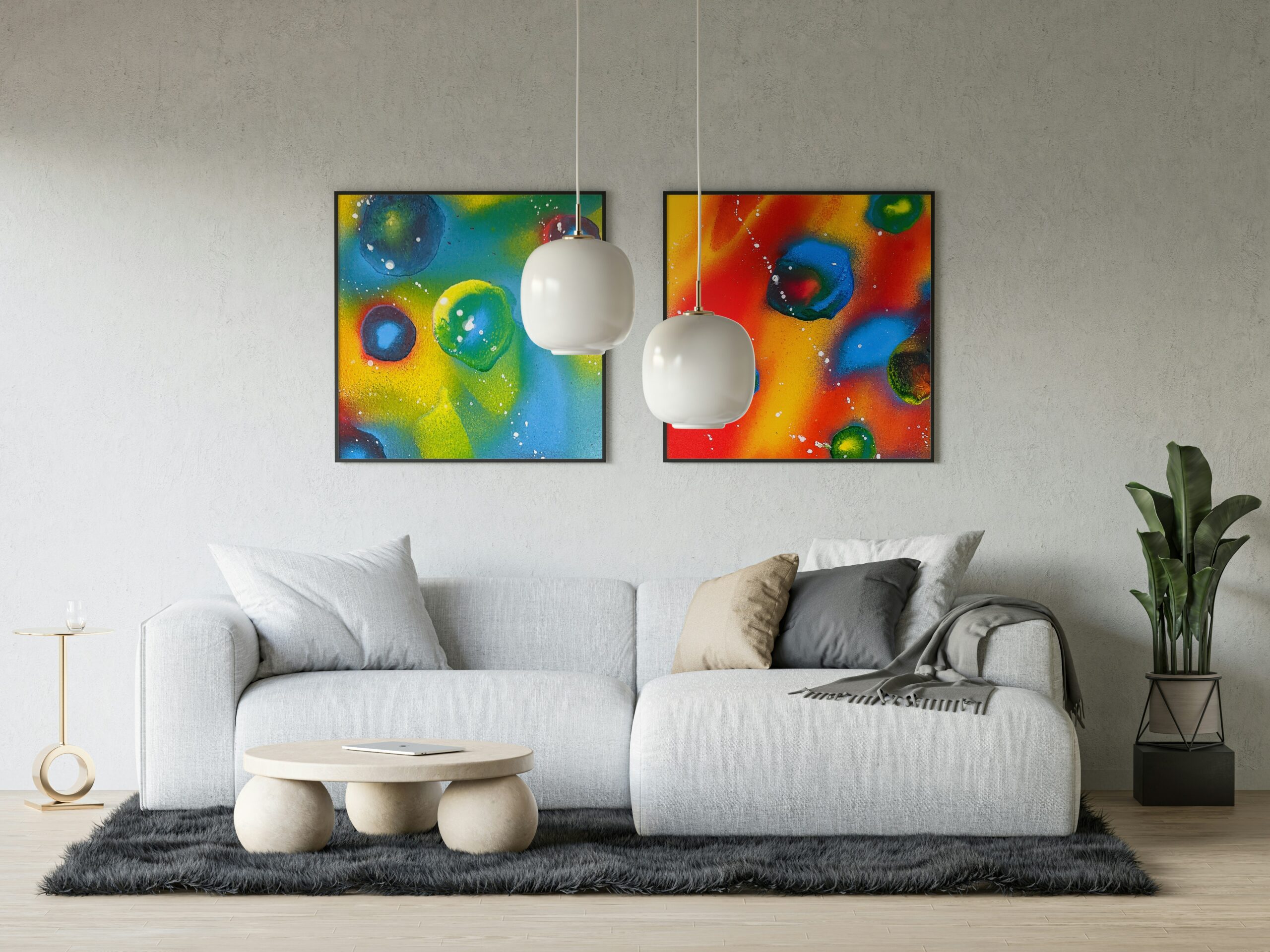
The Sofa Rule: Art hung above furniture should be:
- 15-20cm above furniture top
- Width: 2/3 to 3/4 of furniture width
- Visually anchored to furniture, not floating randomly
The Dining Table Rule: Chandelier hangs 75-90cm above table. Art on walls follows 48-52 inch center rule (seated viewing).
The Bed Rule: Headboard art: 15-20cm above headboard, centered. Maximum 2/3 headboard width (generous negative space).
The Italian Violation: Italians sometimes ignore furniture relationships entirely, hanging art based purely on architectural features. Works in palazzos with 4m ceilings, questionable in 2.4m apartment.
Rule 3: Mind the Proportions
The Scale Problem: Tiny art on vast wall = lost. Oversized art in tiny room = overwhelming.
The Guidelines:
- Art should occupy 50-75% of available wall width
- In large spaces, group smaller pieces to create larger visual mass
- Single statement piece needs adequate wall space to breathe
The Scandinavian Restraint: Nordic interiors favor generous negative space around art—letting pieces breathe rather than maximizing wall coverage. One large piece per wall, substantial spacing.
Gallery Wall Strategies
The Grid Method (Easiest for Beginners)
The Approach: Identical frames, identical spacing, arranged in perfect grid. Symmetrical, organized, foolproof.
The Formula:
- 5-8cm between frames horizontally and vertically
- Frames aligned perfectly (tops, bottoms, sides)
- Overall arrangement forms clean rectangle
Best For: Collection of similar-sized prints, photos, or artworks. Modern, minimal aesthetics.
The German Precision: Germans excel at grid galleries—perfectly spaced, mathematically precise. Use laser levels and measuring tapes religiously.
The Salon Style (Eclectic, Curated)
The Approach: Mixed frame sizes and art types, densely arranged, covering wall floor-to-ceiling.
The Formula:
- 3-5cm between frames (tight spacing)
- Maintain level top or bottom line (even if arrangement feels random)
- Fill entire wall area—no large gaps
Best For: Collected art over time, varied styles, maximalist aesthetics, creating focal wall.
The Parisian Gallery: French apartments often feature salon-style walls—art accumulated over generations, tightly packed, telling stories. Looks curated (because it genuinely is), not random.
The Challenge: Requires strong curatorial eye. Easy to look messy rather than intentional.
The Cluster Method (Balanced Asymmetry)
The Approach: Grouping varied sizes around imaginary center point, creating balanced but asymmetrical arrangement.
The Formula:
- Establish center point (usually aligns with furniture below)
- Arrange outward, maintaining rough balance left/right, top/bottom
- 5-10cm spacing between pieces
Best For: Living rooms above sofas, hallways, creating interest without rigid structure.
Process:
- Lay arrangement on floor first
- Photograph it
- Trace pieces on kraft paper
- Tape paper templates to wall
- Once satisfied, nail through paper, remove paper, hang art
The Dutch Practicality: Netherlands favors this method—balanced but not rigid, works with varied collections, adaptable as collection grows.
The Statement Piece Approach
The Approach: One significant artwork, generous negative space surrounding.
The Formula:
- Single piece occupies 40-60% of wall
- Centered on wall or furniture below
- Nothing competing for attention
Best For: Large original art, bold pieces, minimal aesthetics, letting art breathe.
The Scandinavian Default: Swedish interiors frequently feature single large-scale art pieces—photography, abstract paintings, textiles. Quality over quantity, breathing room essential.
Frame Selection Matters More Than You Think
Matching vs. Mixing
Matched Frames:
- Creates cohesion
- Best for collections, grid arrangements
- Safe, professional looking
- Can feel corporate if not balanced with warmth
Mixed Frames:
- Adds character
- Best for salon style, eclectic collections
- Requires good eye to avoid looking random
- More personality but higher difficulty
The Compromise: Consistent frame style (all wood, all thin black) but varied sizes. Unity with flexibility.
The British Gallery Standard: UK galleries often use simple, consistent framing—thin black or natural wood. Lets art shine, creates visual calm.
Mat Boards (Passe-Partouts)
The Purpose: Create breathing room between art and frame, add perceived value, protect art.
The Guidelines:
- 5-8cm mat border minimum for small prints
- 8-12cm for larger pieces
- Bottom border traditionally slightly larger (optical illusion correction)
The Museum Quality: Quality framing uses acid-free mats, UV-protective glass, proper backing. Costs €100-300 per frame but preserves art properly.
The Affordable Alternative: IKEA frames with white mats look significantly better than frameless mounting. €20-40 per frame, massive improvement.
Color Considerations
Safe Choices:
- White/cream mats (97% of situations)
- Natural wood frames (versatile, warm)
- Thin black frames (modern, crisp)
Bold Choices:
- Colored mats (requires confidence, can date)
- Ornate gold/silver frames (traditional, formal)
- Wide contemporary frames (statement-making)
The Rule: Frame and mat should enhance art, not compete with it. If unsure, go simple.
Lighting Your Art
The Impact
Proper lighting transforms art from “nice” to “gallery-quality.” It’s often the missing element in home displays.
Picture Lights
The Classic: Small fixtures mounted above frame, illuminating artwork directly.
Cost: €40-150 per light Best For: Traditional spaces, statement pieces, formal rooms Installation: Wiring required (unless battery-operated)
The British Heritage: UK homes with traditional art collections use picture lights extensively—brass fixtures illuminating oils and prints.
Track Lighting
The Modern: Adjustable spotlights on ceiling track, directing light to art.
Cost: €150-400 for system Best For: Contemporary spaces, gallery walls, flexibility Advantage: Rearrange art without rewiring lights
Recessed Spotlights
The Minimal: Ceiling-mounted spots angled toward art.
Cost: €200-500 (installation-heavy) Best For: New construction, renovations, clean aesthetics Limitation: Fixed positions—moving art requires new lights
Ambient Lighting Strategy
The Reality: Most homes can’t install dedicated art lighting. The compromise? Ensure adequate ambient lighting with strategic lamp placement.
The Tip: Position floor lamps or table lamps to cast light toward art walls. Not perfect but better than art disappearing in shadows.
Common Display Mistakes (And Fixes)
Mistake 1: Hanging Too High
The Problem: “Eye level” interpreted as standing-and-looking-up level. Art floats near ceiling.
The Fix: Use the 57-inch rule religiously. Feels lower than instinct suggests, but it’s correct.
Mistake 2: Ignoring Scale
The Problem: Postcard-sized print on 3m wall, or massive canvas in tiny powder room.
The Fix: Art should occupy significant portion of available space—not all, but substantial. Group small pieces to create larger visual presence.
Mistake 3: Random Spacing
The Problem: Pieces hung wherever nails happened to go in easily. No relationship to each other.
The Fix: Consistent spacing (5-10cm between pieces), alignment (tops, bottoms, or centers), intentional arrangement.
Mistake 4: Bare Walls and Random Art
The Problem: Three walls empty, one wall crammed with everything.
The Fix: Distribute art across multiple walls, creating balance. Better to have small pieces in multiple locations than everything clustered.
Mistake 5: Wrong Room, Wrong Art
The Problem: Bold abstract in formal dining room, delicate watercolor in kids’ playroom.
The Fix: Match art to room function and aesthetics. Dramatic pieces in social spaces, calming art in bedrooms, personality in personal spaces.
Art in Specific European Spaces
Stairways and Hallways
The Opportunity: Vertical walls perfect for ascending arrangements.
The Approach:
- Maintain 57-inch rule at midpoint of stairs
- Create ascending or descending line following staircase angle
- Alternatively, horizontal line with stairs creating diagonal negative space
The Victorian Solution: British Victorian homes feature elaborate stairway galleries—family portraits, prints, creating “conversation” as you ascend.
Small Spaces
The Strategy: Large-scale art makes small rooms feel bigger (counterintuitive but true). Numerous small pieces make spaces feel cluttered.
The Rule: One substantial piece better than three small ones.
High Ceilings
The Challenge: Art hung at standard height looks lost. Ceiling dominates.
The Solution:
- Larger-scale art
- Stack vertically (multiple pieces ascending)
- Embrace high placement if room warrants
The European Palazzo: Italian apartments with 4m+ ceilings feature art stacked in tiers—major pieces at 57 inches, secondary pieces above. Fills wall appropriately for proportions.
The Bottom Line
Displaying art well combines mathematical precision (measurements, spacing) with aesthetic judgment (arrangement, selection, balance). The math is learnable. The aesthetics improve with practice.
Start with fundamentals:
- 57-inch center rule
- Consistent spacing
- Proportionate to wall/furniture
- Proper lighting (even if just improved ambient)
- Unified framing approach
Your art doesn’t need to be expensive to be displayed beautifully. €30 prints in proper frames at correct heights look more impressive than €500 originals randomly nailed up.
The difference between “we have art” and “we know how to display art” is mainly about respecting these principles.
Now go remeasure everything. It’s probably too high.
Framing Resources:
- Quality Framing: framebridge.com, kingandmcgaw.com
- Affordable Frames: ikea.com, desenio.com
- Gallery Inspiration: nationalgallery.org.uk, rijksmuseum.nl